
An Open Letter to Commissioner Kay Carvajal Moran
By Jonathan Carlson, Executive Editor, MPLS Page
For much of its history, Minneapolis has congratulated itself for being a progressive city. We celebrate inclusion, historic preservation and public access. We speak positively about equity.
Today, the Minneapolis Park & Recreation Board’s “Hiawatha Golf Links Master Plan” presents a test of whether those values are real when keeping them means recalibrating institutional direction.
Commissioner Carvajal Moran, you have inherited more than a golf-course debate. You have inherited one of the most consequential civil-rights preservation decisions facing Minneapolis today.
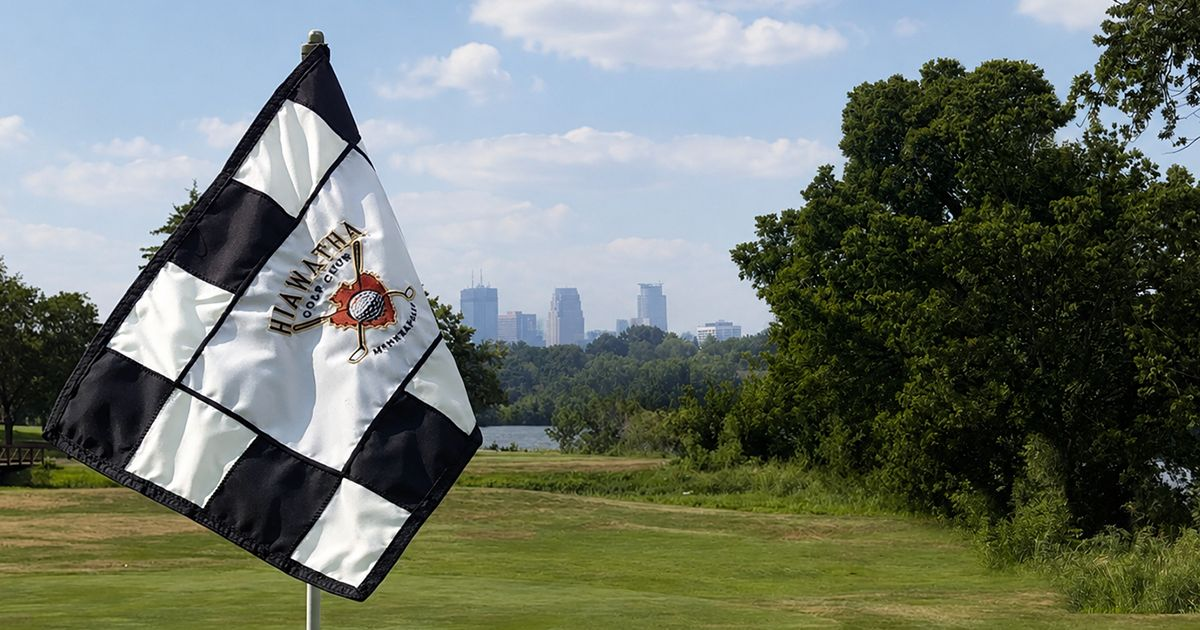
Hiawatha is not simply 140 acres of municipal golf. It is a living cultural landscape where Black Minneapolis residents challenged exclusion, built institutions, developed athletic excellence and created a community gathering place during decades when racial covenants, redlining and discrimination sharply restricted where they could live and participate in public life.
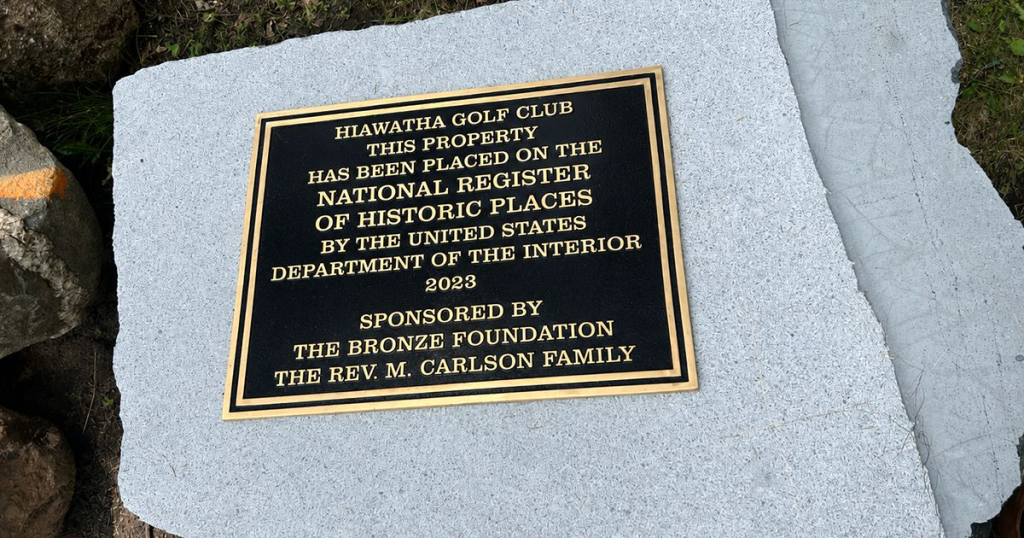
In 2023, the federal government placed Hiawatha Golf Course on the National Register of Historic Places. The designation recognized the course’s importance in recreation, Black ethnic heritage and Minneapolis social history. The property listed was not merely the clubhouse or a commemorative marker. It was the historic golf-course landscape— including the 18-hole course that gave these civil-rights achievements their physical and social setting. We celebrate this designation Saturday at the Bronze Golf Tournament with a bronze plaque permanently mounted on a black-and-white piece of granite.
Yet the Minneapolis Park and Recreation Board continues designing a future in which that 18-hole landscape is eliminated and replaced with nine regulation holes, substantially expanded wetlands, new trails and other recreational amenities.
Calling nine holes played twice an “18-hole experience” does not preserve an 18-hole golf course. Repeating the same nine holes from different tees does not preserve the historical landscape on which generations of Black golfers learned, competed in 18-hole tournaments, organized and built community.
The 9-hole Plan replaces it.
Environmental Justice Requires Better Choices
The Park Board has framed the Hiawatha debate as a choice between environmental responsibility and golf. That framing has always been too limited, too convenient.
The serious question is not whether Hiawatha has water-management challenges. It does. The serious question is whether destroying a nationally recognized historic landscape is necessary to address them.
Minneapolis-born water engineer Andy Komor developed an alternative approach intended to preserve all 18 holes while addressing flooding, water quality and pumping. The Park Board asked him to present it at its April 6, 2022 meeting. The following morning, a commissioner and an ally filed an ethics complaint questioning Komor’s Minnesota licensure status. That response raised a larger question: why was a preservation-compatible engineering alternative met first with a licensing challenge rather than a transparent technical comparison?
The existence of a competing engineering proposal does not prove that proposal is perfect. It does prove that the 9-hole Plan is not the only imaginable answer.
A public agency proposing irreversible changes to a National Register property should be required to demonstrate—with independently reviewable engineering, financial and preservation analysis—that no reasonable preservation-compatible alternative exists.
That showing has not been made.
Golf is not culturally neutral
The widely-held political narrative, advanced by a previous District 5 Commissioner, often presents golf as an inherently wealthy, white and exclusionary use of public land.
That stereotype does not describe Hiawatha.
Hiawatha became important precisely because Black golfers were excluded elsewhere. The Twin City Golf Club (TCGC) formed in 1934 because Black players could use municipal courses but were excluded from the affiliated white clubs and the privileges that came with membership. Solomon Hughes Sr., a championship golfer and teacher, helped lead the struggle for access. The Hiawatha clubhouse was opened to Black golfers in 1952 after years of organized pressure.
The Upper Midwest Bronze Amateur Tournament transformed the course into a regional destination. Black golfers and families came from across the Midwest. The event combined competition, fellowship, mentorship and civic life. The Bronze Tournament continues today. And so do the descendants of the TCGC, who gather after their round of golf every Tuesday afternoon in the corner of the parking lot, known as “Amen Corner.”

This is what preservation professionals mean by a living cultural landscape. The history did not stop when the period of historical significance ended. Its descendants and institutions still occupy the site and continue its traditions.
The Park Board would never suggest that replacing half of a historically important theater with generic community space preserved the theater because performances could still occur in the remaining half. It never suggested making Meadowbrook Golf Course 9 holes even when they had to close it for three years after the 2014 flood.
The 9-hole proposal applies exactly that logic to Hiawatha.
In fact, during the early years of Black activism for equal access to public golf, 9-hole courses were constructed as “consolation prizes” to Black communities in Gary, IN and Nashville, TN whose governments had already built 18-hole courses for whites only. In
2022, Rick Shefchik, Minnesota’s premier historian of golf, wrote an open letter to the MPRB:
“The symbolism of reducing Hiawatha to a 9-hole course – a designation limited to so-called executive, par-3, rural and learning courses – is unfortunate at best. And though motivations for this proposal are no doubt honorable and well-intentioned, the negative impact on Hiawatha’s historically diverse constituency cannot be minimized.”
The 9-hole Plan was not supported by the community
In July 2020, the MPRB asked for written comments about the 9-hole Plan. 347 people sat down in the Clubhouse and wrote their opinions. The Park Board did not provide those written comments until they were requested under the Minnesota Government Data Practices Act. When Kathryn Kelly, whose family lives on Longfellow Ave., analyzed them, she listed the Top Dozen:
#1- 196 “Keep the 18-hole course”
#2- 41 “Reject/bad Plan, waste of money”
#3- 38 “Honor Black golfers”
#4- 33 “9-hole is unsustainable, money loser, beginners only”
#5- 29 “Water plans won’t work”
#6- 29 “Amenities already exist”
#7- 26 “Golf course there for kids”
#8- 23 “Diverse golf course important”
#9- 22 “18-hole golf course is neighborhood institution”
#10- 22 “Redesign/upgrade current 18-hole course”
#11- 20 “Support the 9-hole Plan”
#12- 20 specifically urged the Park Board to invest in existing infrastructure—a concern given questions about the climate resilience and condition of Park Board facilities.
The equity question has been turned upside down
Supporters of redevelopment describe new trails, wetlands, paddling facilities and gathering spaces as an expansion of public access.
But public access for whom—and at whose loss? At whose gain?
Trails, wetlands, boardwalks and environmental education are legitimate public uses. Minneapolis already maintains an extensive park and trail system, and Lake Hiawatha already includes public park facilities outside the golf course.
What Minneapolis does not have are many historic public spaces where Black community institutions overcame exclusion and remain visibly active.
Equity is not achieved by counting amenities. It requires asking who built the social meaning of a place, who continues to depend upon it and who loses something that cannot be recreated elsewhere.
The proposed plan would take a historically Black 18-hole golf landscape and reduce it to a smaller recreational component within a substantially different park. That is not preservation through adaptation. It is displacement through design.
Commissioner Carvajal Moran has inherited the decision
District 5 Commissioner Kay Carvajal Moran did not create this displacement. She took office in January 2026 after defeating the incumbent and now represents the district containing Hiawatha. Her official biography describes her as a progressive, first-generation Mexican American raised in South Minneapolis and committed to a park system that works for everyone.
During her campaign, she publicly supported the Hiawatha Master Plan, writing that it “recognizes the historical contributions of Black golfing leaders.”
Commissioner Carvajal Moran must challenge the assumptions of the previous Board and use the latest plan as an opportunity to insist on a fresh examination grounded in civil rights, historic preservation, engineering reality and the voices of the people whose community created Hiawatha’s national significance.
Her responsibility is larger than deciding how many golf holes should remain.
She must decide whether Minneapolis means what it says about protecting historically marginalized communities.
The correct first step is not to pick sides, but to examine the project with fresh eyes and without a predetermined outcome.
That process should include:
- A direct assessment of how each proposed design would affect the contributing features and integrity of the National Register-listed district.
- A transparent, independent comparison of the Park Board Plan and preservation-compatible alternatives, including Komor’s Alternative 6.
- Complete disclosure of project costs, funding sources, golf-enterprise accounting and anticipated federal permits.
- Formal participation by the Bronze Foundation, SaveHiawatha18, historic preservation organizations, golfers, neighbors and Dakota representatives.
- A presumption against irreversible alteration until state and federal historic review obligations are resolved.
Two histories do not have to cancel each other
Lake Hiawatha has important Dakota history. That history deserves rigorous research, interpretation and respect.
Recognizing Dakota history does not require erasing Black history. The question before Minneapolis is not which marginalized community deserves recognition. A just city should reject that premise entirely.
Restoring wetlands or wild-rice habitat may address a historical injustice. But dismantling the 18-hole golf course would perpetuate another. That is a false moral choice. A credible preservation plan should be additive. It should interpret Dakota history, improve water quality and preserve the civil-rights landscape.
Justice is not served when one historically marginalized community is asked to surrender its living cultural institution so another public objective can be achieved.
The State Historic Preservation Office emphasizes that historic significance requires evidence, integrity and careful boundary analysis. Meanwhile, the existing golf-course district is already listed and its contributing 18-hole landscape is physically present, historically documented and actively used.
The burden belongs to the government to prove that these objectives cannot coexist— not to the Black community to explain once again why its surviving institutions still matter. Minneapolis’ civil rights history deserves more than a plaque and renaming
The Bronze Foundation will dedicate a marker recognizing Hiawatha’s National Register status during the Upper Midwest Bronze Amateur Tournament, July 25, 2 pm.
The plaque is important. But a plaque cannot substitute for the place it describes.
Government institutions often act as if they honor marginalized communities after the fact. They rename a building, install a marker, celebrate a historical figure and then make land-use decisions that weaken the living institution carrying that history forward. After the 9-hole Plan was voted down at least two times, the MPRB named the Clubhouse after Solomon Hughes, Sr. But his son wrote an Op Ed published 8/29/2022 in the Star Tribune, titled, “Do not destroy Hiawatha golf course, my father’s name is above the door.” The following week, on its fourth attempt, the Board approved the 9-hole Plan.
In practical terms, that vote authorized the dismantling of the historic 18-hole layout.
Preservation is not symbolism.
It means retaining the defining characteristics that allow a place to communicate its history.
For Hiawatha, that means the 18-hole course, the clubhouse, the tournament traditions, the spatial relationships and the multigenerational community that continues to gather there.
Commissioner Carvajal Moran has an opportunity to prevent Minneapolis from making a familiar mistake: praising a community’s history while removing the ground beneath it.
She has been invited to attend the Bronze Tournament. She could meet the descendants of the golfers who fought for access. She should walk the course, study the National Register nomination and demand an honest comparison of the alternatives.
Then she should lead the Park Board toward a solution that improves water management without destroying the landscape Minneapolis has finally understood is historically significant.
Hiawatha does not need to be preserved because golf is sacred.
It needs to be preserved because civil-rights victories embodied in public space are rare, fragile and easily erased by institutions convinced they have found a more fashionable use for the land.
A progressive city should understand that.
Civil rights history deserves more than a plaque.
It deserves a place.
Commissioner Carvajal Moran now has the opportunity—and the responsibility—to ensure that Hiawatha has both.
About the Author: Jonathan Carlson is Executive Editor of MPLS Page, an environmental and social justice advocate, and an avid golfer. He has been active in efforts to preserve Hiawatha Golf Course and was the principal financial backer of the historical research, preparation and submission of the successful application that placed Hiawatha Golf Course on the National Register of Historic Places. His support was made in honor of his father, the Rev. Merle Carlson, whose name appears on the commemorative plaque.





3 Responses
Thank you for input. Very well said.
Hiawatha Golf Course is an asset for the City of Minneapolis. It’s relatively close proximity to the airport, Mall of America and an extensive array of Hotels allows visitors an option of a heathy activity. I worked at Hiawatha under Don Nelson and Bob Nordstrom. It wasn’t uncommon for all of our rental clubs to out. Many visitors commented how fortunate we were to have a golf course so close to the inner city, I also learned to play at Hiawatha.
The will of the people! The Park Board seems to have their own agenda. This should be an easy decision. The people want 18 holes at Hiawatha National golf club. Tell me again is against keeping Hiawatha National as 18nholes? One Park Board member. Listen to the people and keep Hiawatha National at 18 holes!